
Every revenue leader I know has a company they quietly measure themselves against. Not always a competitor. Just a team whose pipeline seems to arrive on schedule, whose reps always seem to know who they're talking to, and whose follow-up never seems to slip.
For a long time I assumed they had better tools. Mostly, they don't. Look under the hood of the B2B teams that run revenue best and you'll find many of the same products everyone else buys. What you'll also find is the thing nobody sells you: a system that joins them up, built over years, by people whose whole job is keeping it joined.
That system is the real advantage. Until recently, the only way to get one was to build it yourself.
The short version
- The best teams don't win on tools. They win on a system: signals, research, routing, replies, booking and recovery, running in order, on one record.
- They built it over years, with GTM engineers, RevOps and data specialists holding it together.
- Buying the same tools without the system gives you a Franken-stack: the parts of a revenue engine with nothing running it.
- What has changed is that agents can now run that system, trained like a new hire, so a team without a platform team can run revenue the same way.
What the best teams actually built
Strip away the logos and the system does six things, every day, for every lead and every account. None of them is exotic. The difference is that all six happen, in the right order, without anyone having to remember to do them.
1. They know exactly who they're for
The ICP isn't a slide from last year's planning offsite. It's written down in enough detail to be applied, and it is applied, to every lead and every account, the moment they appear. A score exists before a rep's name is attached to anything. If you've never seen fit and intent pulled apart, our piece on lead qualification is the place to start.
2. They hear buyers before buyers raise a hand
Most buying happens before anyone fills in a form. The best teams treat that as signal, not noise: the target account reading the pricing page, the company that just hired a new VP of Sales, the people engaging with your founder's posts, the free signup at a company that fits the ICP. Each one is caught, matched to an account and acted on while it still means something. Most of your traffic leaves without a word, and the best teams have decided that isn't acceptable.
3. Every record arrives complete
A name and an email address is not a lead. Before anyone acts, the record is enriched across several providers, verified, and researched: what the company does, what's changed there recently, what this person is likely to care about. The rep, or the agent, starts from a brief, not a blank page.
4. The right person gets it, first time
Before any routing rule fires, something checks whether the account already has an owner, whether the person is already in a sequence, and whether a colleague of theirs is already in conversation with you. Only then does the lead go anywhere. It sounds basic. It's one of the first things to break in most stacks, and one of the four places inbound reliably fails.
5. Every conversation is answered in context
Replies don't sit in a shared inbox waiting for a free pair of hands. They're answered with what the company actually knows: the product, the pricing logic, the objections and how to handle them, and what this buyer has already been told. When the moment is right, the meeting is booked inside the reply, with the right rep, on a calendar that already knows who that is.
6. Nothing dies quietly
A cancelled meeting starts a follow-up. A no-show gets a rebook. A lead who isn't ready gets nurtured on rules, not forgotten. The best teams don't have fewer dead ends than you. They have something that notices every one of them, which is the difference between a meeting that died and the meeting nobody owns.

One record, every motion
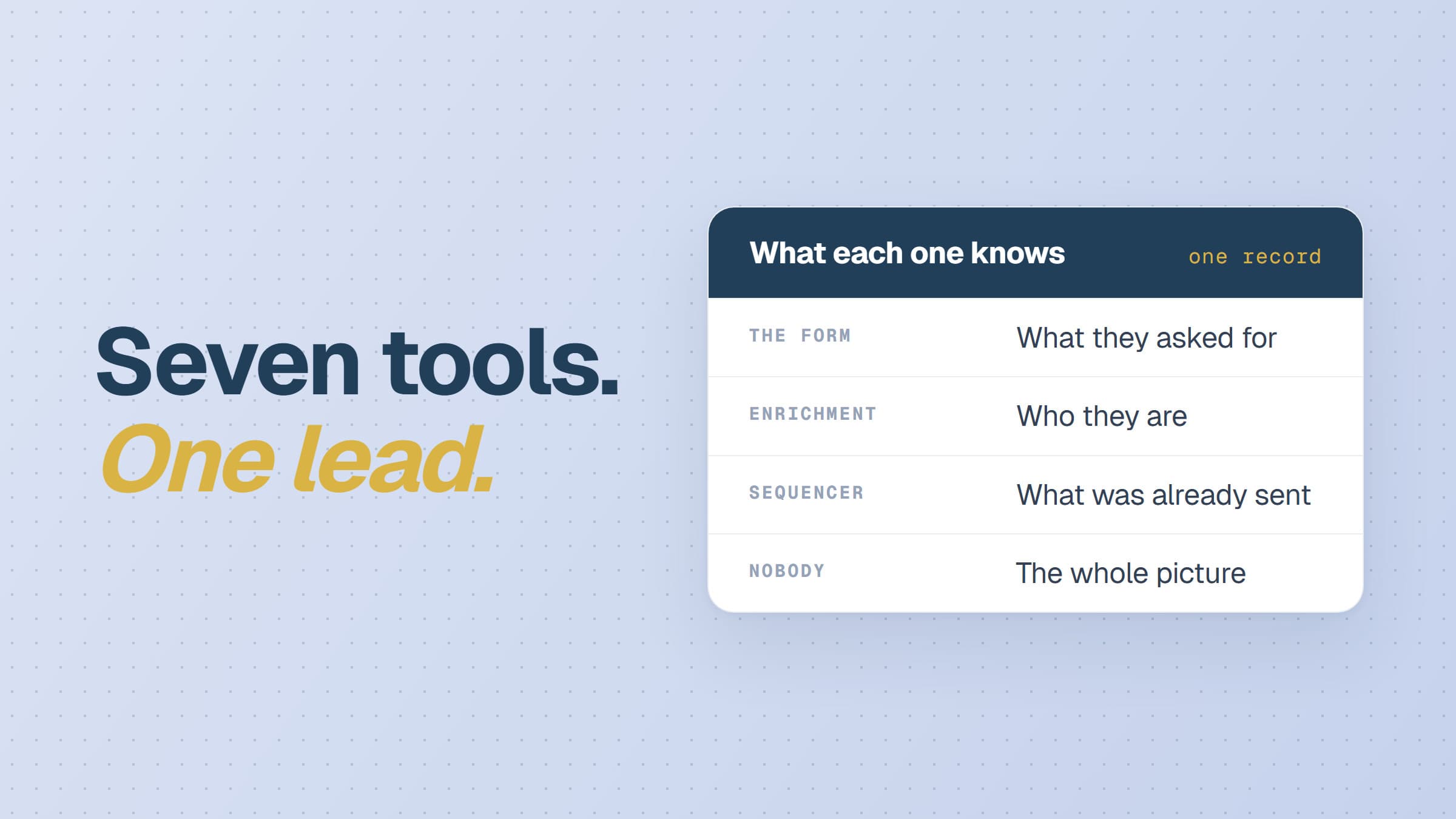
The quiet trick underneath all six is that they happen on one record. Inbound, outbound and ABM aren't three teams with three toolsets. They're three ways a buyer enters the same system, so the account that booked a demo on Tuesday doesn't get a cold sequence on Wednesday, and the rep walking into the call can see every touch that came before it.
This is the part most teams underestimate, because it doesn't look like a feature. It looks like nothing going wrong. We wrote about what happens without it in Seven tools, one lead, and nobody remembers the conversation.
Why it took them years
Nobody bought this system. It was assembled, and it's worth being honest about what the assembly took.
A GTM engineer to wire enrichment, scoring and routing together, and to write the automations that pass records from one tool to the next. A RevOps lead to keep the CRM honest and the syncs running. Often a data specialist to manage providers and lists. SDRs spending a real slice of every day on research the system couldn't do. And years of iteration, because every rule in there exists because something went wrong once.
Then the maintenance, which never stops. A vendor renames a field, a sync starts dropping records, the person who built the routing logic moves on, and the system degrades quietly until someone notices the pipeline number doesn't add up.
The best teams don't have better tools than you. They have the thing that joins the tools up, and someone whose whole job is keeping it joined.
Why buying the same tools gives you a Franken-stack
Here's the trap most growing teams walk into, and I've watched very smart people walk into it with their eyes open. They see what the best teams use, they buy the same categories of tool, and they expect the same results.
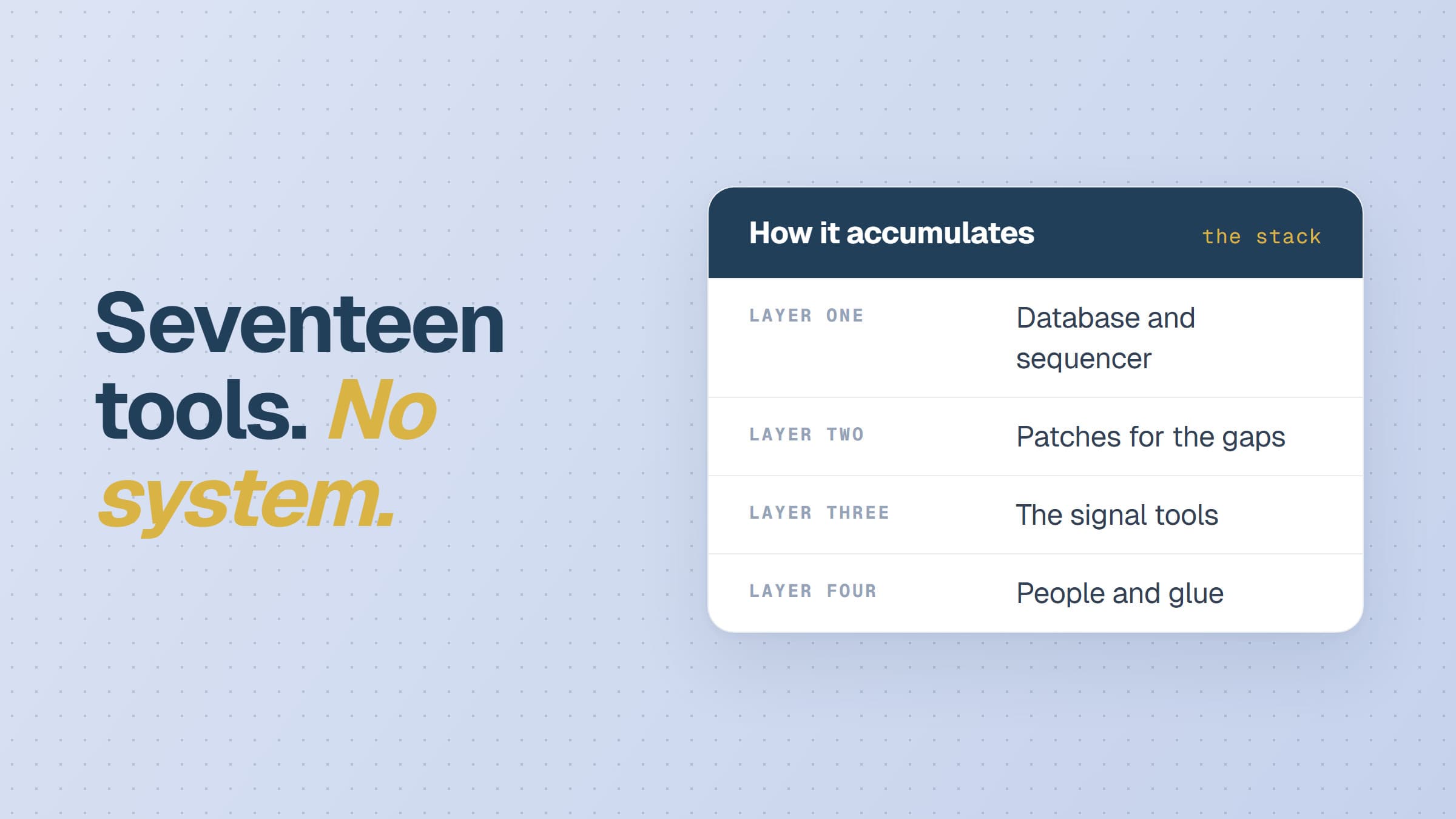
What they get instead is a Franken-stack: a contact database, a sequencer, enrichment tools, a scheduler, a form tool, a router, an intent feed, a visitor reveal tool, an AI SDR subscription and a chat widget, each good at its own job and none responsible for the space between. Seventeen tools or more, and not one of them knows the whole story.
The parts are not the system. The system is the order the parts run in, the record they share, and the judgement applied at every step. Buy the parts without those and you've bought the shape of a revenue engine with nothing running it. If you're not sure which side of that line you're on, there are six signs worth checking.
What changed: agents can run the system
For most of the last decade the choice was binary. Either you invested years and a platform team in building the system, or you lived with the stack.
That's no longer the only choice. The six jobs above are exactly the kind of work agents are now good at, provided they're given what a good hire would be given. Not a 300-character tone-of-voice box: the deck, the pricing logic, the battle cards, the objection handlers, the ICP. Trained like a new hire, an agent can research an account, write to the buying committee, answer the reply, route the lead and book the meeting, inside rules you set, with a human approving as much or as little as you want.
Two things follow from that. The system no longer needs a platform team to hold it together, because you can describe what you want in plain English instead of wiring it. And anyone on your revenue team can run it, not just the one person who understands how the automations connect. That raises a question every revenue leader should be asking, and we've taken it on directly in Do you need a GTM engineer, or a stack that doesn't need one?
Where to start, whatever you run today
You don't need to replace anything to start running revenue like the best teams. You need to see your own system clearly first.
- Write the ICP down in enough detail that a new hire could apply it to a lead in under a minute. If a person can't, nothing downstream can either.
- Map what happens in the first hour after a lead appears, step by step, and note which tool owns each step. The gaps between owners are where pipeline goes.
- List the buying signals you already collect and where each one lands. A signal that arrives in a tool nobody opens is a signal you don't have.
- Take last week's cancelled meetings and trace what happened next. If the answer is nothing, that's your first fix.
- Ask who could explain your routing logic if the person who built it left tomorrow.
How Lazure approaches this
Lazure is the system the best teams built, as one platform, run by agents. It finds your buyers across 500M+ people and 95M+ companies, enriches them across 50+ providers, and catches the signals in between: website visitors, social engagement, product signups, form fills and replies. It scores every lead against the ICP you write, checks ownership in HubSpot, Salesforce, Attio or Zoho before anything is routed, writes and sends across email and LinkedIn, answers replies from a knowledge base you train it on, books the meeting on a built-in calendar, and follows up when a meeting dies.
It runs inbound, outbound and ABM on one record, so every motion knows what the others have done. On Command, specialist agents take on whole jobs from a plain-English ask: find the prospects, build the sequence, prepare tomorrow's brief, explain where this week's meetings came from. Your team stays in charge of the rules and the relationships. The system does the rest.
If you want to see what that looks like on your own market, book a demo and we'll build it with you live.