
Every revenue team has a process for the meeting that happens. Notes get written, the CRM gets updated, a next step gets agreed, someone follows up. It is the best-instrumented thirty minutes in the whole funnel.
Almost none has a process for the meeting that does not. The invite expires, or the prospect cancels on a Friday afternoon, or nine-thirty arrives and nobody joins. And then, in most stacks, nothing happens at all. No task, no trigger, no alert. The slot simply disappears from the calendar and the lead goes quiet, and because no system logged a failure, no report will ever show you the cost.
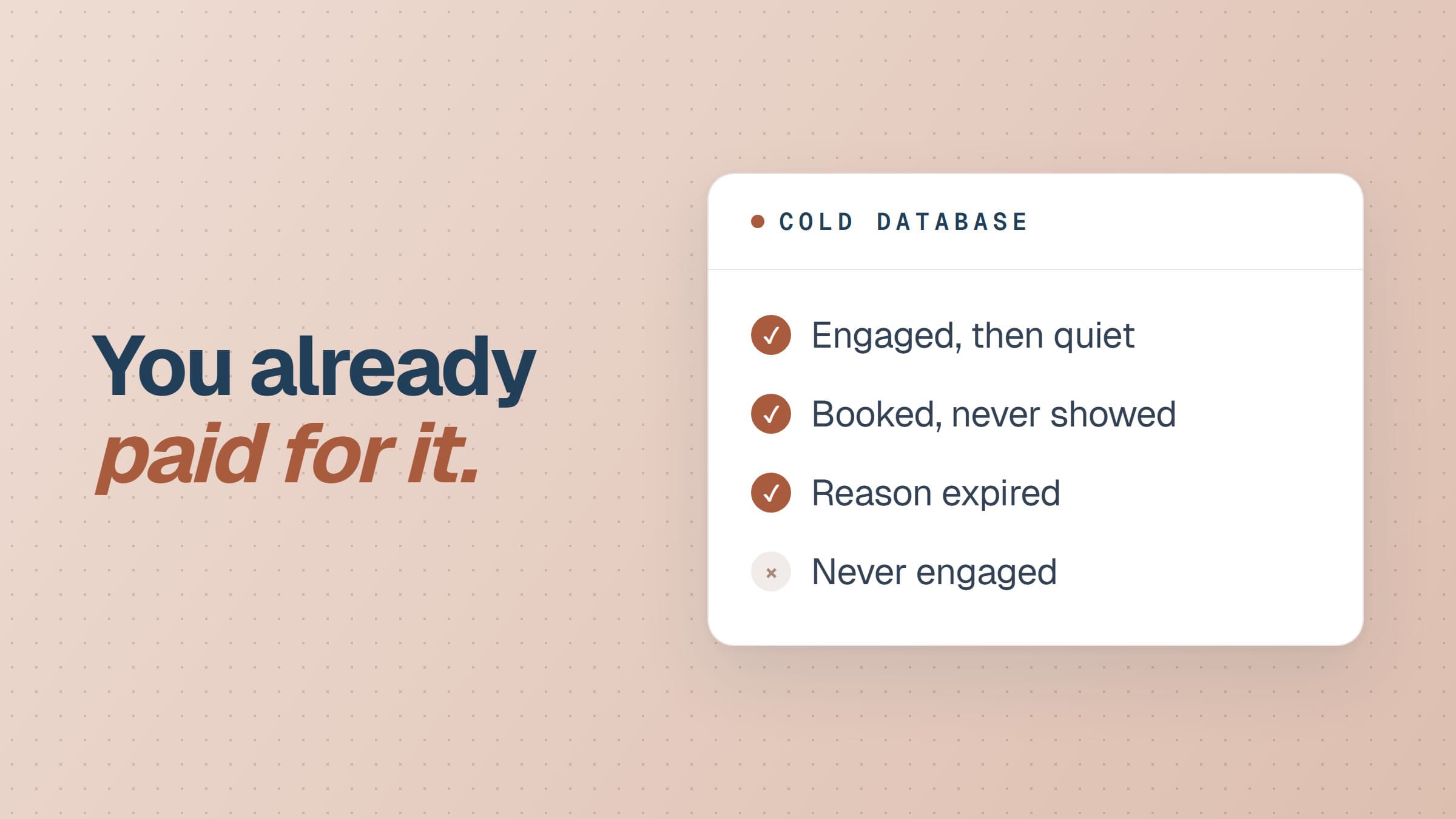
This is the most recoverable money in the funnel, and it is almost entirely unclaimed.
The short version
- A dead meeting is pipeline you already paid for. The acquisition cost is spent.
- No-show, late cancel and expired invite are three different failures needing three different responses.
- Nothing logs it, so nothing reports it, so nobody owns it.
- The recovery message only works if it knows what the meeting was about.
- There has to be a rule for when to stop, and it has to be written down.
The most expensive thing on this list
A meeting that does not happen is not a scheduling problem. It is pipeline you already paid for, sitting one message away from being recovered.
Work out what you spent getting somebody to book. The campaign, the content, the form, the routing, the calendar, the reminder. Every bit of that cost is sunk by the time the invite lands. The only thing that separates a booked meeting from a held one is the follow-up you either sent or did not.
Which makes recovery the cheapest pipeline available to you. There is no new acquisition cost, no new list, no cold opener to write. The person already told you they were interested enough to give you calendar time. You are not persuading a stranger, you are rescheduling with someone who already said yes once.
The 2026 numbers make the scale of it hard to ignore, and they disagree with each other for a reason worth understanding. Median B2B demo show rates land around 55 to 65 percent, while one analysis of several thousand meetings found no-shows closer to 6 percent. Those are not competing measurements of the same thing. A demo requested from your pricing page and a meeting an SDR extracted from a cold call are different objects wearing the same calendar invite. On cold-booked meetings specifically, the no-show rate has climbed from roughly 18 percent in 2020 to around 32 percent.
Three failures, one word
Three different failures get filed under one word. They need three different responses.
They look the same on a dashboard and they mean completely different things.
The invite that expired is the weakest signal and the easiest fix. Someone opened the scheduler, looked at the times on offer, and closed the tab. Often that is a calendar problem rather than an intent problem: nothing on offer worked, or the first available slot was eleven days out. A short message with different times attached recovers a meaningful share of these, and a scheduler that offers sooner slots prevents most of them.
The late cancel is the strongest signal of the three, and the one most likely to be treated as a rejection. Somebody who cancels has usually had something break in their week rather than a change of heart. Cancelling is what people do when they still intend to meet you but cannot on Thursday. The right response is a reschedule offered within the hour, not a polite note saying to reach out whenever suits.
The no-show is the awkward one, because it carries a small social debt. They know they missed it. A message that is clearly annoyed makes it worse, and a message that pretends nothing happened reads as automated. The version that works is short, assumes the good reason they probably had, and makes rebooking a single click.

Cancelling is what people do when they still intend to meet you, but not on Thursday. Most stacks treat it as a no.
Why nothing catches it
The reason this goes unfixed is not that teams do not care. It is that a dead meeting produces no record anywhere.
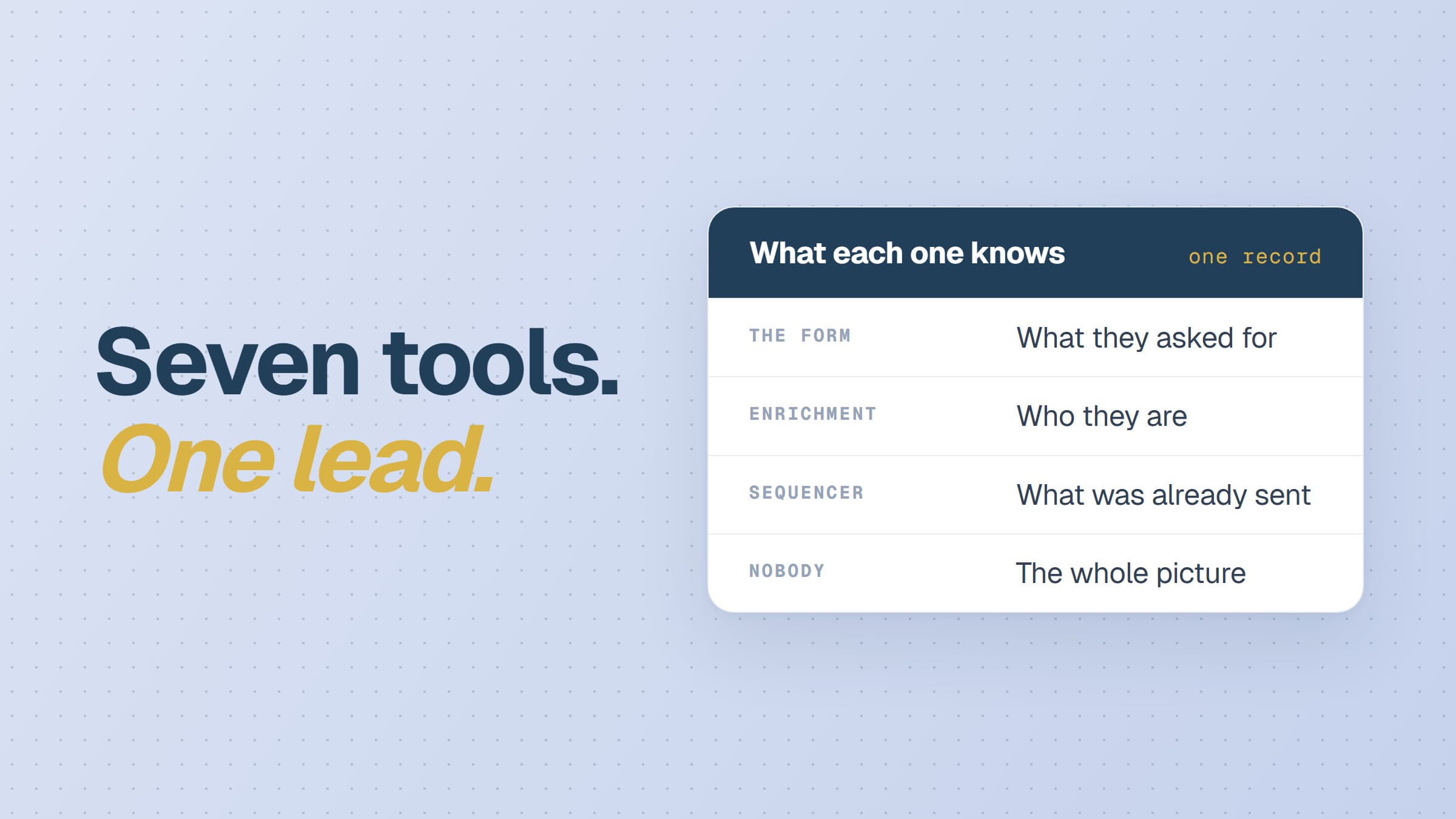
Think about what each system reports. The calendar tool reports that an invite was sent, and it was. The CRM reports a meeting object, which either never gets updated or gets marked as something ambiguous weeks later. The sequencer reports that its sequence completed, because from its point of view it did. Every tool in the chain reports success, because each one did the job it was built to do.
Nothing in that chain is responsible for whether the meeting actually happened. So nothing fires, nothing alerts, and the number never appears in a report that anyone reviews. The only person who feels it is the rep, who notices a quiet morning and moves on to the next thing on the list.
This is the same failure mode as most revenue leaks. It is not a missing capability. It is a seam between tools where nobody has written down whose job the outcome is.
What the recovery message has to carry
The recovery message has to know what the meeting was about. Otherwise it reads as a form letter, which is worse than saying nothing.
This is where most recovery attempts fail, and it fails in a specific way. The message goes out fast, which is right, and says nothing, which is fatal. "Sorry we missed each other, here is my calendar" is indistinguishable from a bot, because it is one.
The version that gets a reply references the thing they asked about. They booked from the pricing page after reading the integrations section twice. They asked, in the form, whether you handle multi-region routing. Their company announced something last week that is the reason they were looking in the first place. That context existed before the meeting was booked, and it still exists now. The only question is whether the follow-up can reach it.
Timing matters nearly as much. A reschedule offered while the original slot is still in their calendar reads as a continuation. The same message three days later reads as a new sales cycle, and gets treated like one.
Knowing when to stop
Recovery turns into harassment quickly if nobody defines the ceiling, and the ceiling has to be a rule rather than a judgement call made by whoever is having a slow week.
Two attempts on a no-show is usually the honest limit. One immediate, one a few days later with a genuinely different angle, and then the lead goes back to nurture rather than staying in a loop. Someone who has not rebooked after two well-written attempts has answered you.
The same applies to suppression. An account that has gone to a competitor, or has an open opportunity with someone else on your team, or has asked not to be contacted, should be out of the recovery motion entirely. This is the part that people skip, and it is the part that turns a sensible programme into the thing that gets your domain blocked.
What good looks like
A working setup answers three questions before anything is switched on.
What counts as a dead meeting, in specific terms: expired, cancelled, no-showed, each one named. What fires for each, how fast, and with what context attached. And who owns the outcome by name, so that when a meeting dies at 9:30 there is a person, not a hope.
Get those three written down and recovery stops being something a diligent rep does when they remember. It becomes a property of the system, which is the only form of it that survives a busy quarter.
How Lazure recovers meetings
A meeting that changes is a trigger in Lazure rather than an ending.
Meeting cancelled, meeting rescheduled, meeting reassigned and meeting no-show each fire their own workflow, on your timing. The re-engagement goes out with the full lead record attached, so it references what they actually asked for and what has already been said to them, rather than offering a bare calendar link. A reassignment carries that same record to whoever picks the meeting up, so the new owner is not starting from an invite and a name.
The invite that was never booked is the one on this list better prevented than recovered, and that is a scheduler question rather than a workflow one. Offer sooner slots, and fewer of them expire in the first place.
The AI SDR can carry the whole exchange from there, at a speed and persistence that is hard to match by hand across a full pipeline, and it hands back to the owning rep with the conversation attached the moment it earns a real reply. Suppression runs first, so customers, open opportunities and anyone who has asked to be left alone never enter the motion. The rep recovers the meeting without having to notice it died.