
Nobody sets out to build a Franken-stack. I've never met a revenue leader who drew one on a whiteboard and said, let's do this. It arrives the way most expensive things arrive: one sensible decision at a time, each one right on the day it was made.
Then one morning you count, and there are seventeen tools, four people whose job is mostly keeping them talking, and a revenue system that nobody actually designed. This is how that happens, layer by layer, and what it quietly does to your pipeline.
The short version
- A Franken-stack is built in layers: a database and a sequencer first, then tools that patch their gaps, then tools that patch those.
- Every tool is bought to solve a real problem. None is bought to own the space between problems, which is where leads go missing.
- The stack grows its own staff: a GTM engineer, RevOps, a data specialist, and SDRs who spend their mornings on research.
- It works until someone leaves. Then you find out how much of the system lived in one person's head.
Layer one: the starter kit
It begins with two tools and a reasonable plan. A contact database so you have someone to write to, and a cold email sequencer so you can write to them at scale. Add the CRM you already had, and you have a motion.
It works, for a while. Then reply rates slide, bounces climb, and someone points out that a good part of the list is out of date. Which brings you to layer two.
Layer two: patching the gaps
The database isn't complete enough, so you add enrichment tools, usually more than one, because no single provider covers everyone. The sequencer books meetings by pasting a link, so you add a scheduler. Marketing wants better forms, so a form tool arrives. Leads start landing on the wrong rep, so you buy a lead router, and then a lead-to-account matcher, because the router can't tell that a new contact belongs to an existing customer.
Each purchase is defensible. Each one also adds a seam: a place where one tool hands a record to another and trusts that it arrived intact.
Layer three: chasing the signal
By now someone has read that most buying happens before the first conversation, which is true, and so the signal layer arrives. An intent data feed. A visitor reveal tool to see which companies are on the website. A LinkedIn tool. A chat widget. Shared inboxes for the replies. And, more recently, an AI SDR subscription that writes and responds from whatever it's been given, which is usually not much.
Here's the problem with this layer: a signal is only worth something if it's acted on while it's fresh, and every one of these tools delivers its signal somewhere different. The visitor report lives in one dashboard, the intent spikes in another, the LinkedIn engagement in a third. The signal arrives. Nobody is standing where it lands.

Layer four: the glue
With fifteen-odd tools in place, the stack needs holding together. This is the layer that never appears on a vendor's website.
- Automation glue: the workflows that move a record from the form tool to enrichment to the router to the CRM.
- CRM sync scripts that someone wrote once and everyone is now afraid to touch.
- A scoring spreadsheet, because the scoring logic was too specific for any one tool to hold.
- Someone whose real job, whatever their title says, is chasing the meetings that didn't happen.
Then the people. A GTM engineer to build and maintain the automations. RevOps to keep the CRM clean and the syncs running. A data specialist for the providers and the lists. SDRs doing research by hand, because no tool in the chain holds enough to write a brief. These are good people doing real work. A large share of it is keeping the stack from coming apart.
Every tool in a Franken-stack is bought to solve a real problem. Not one of them is bought to own the space between problems, and that's where the leads go.
What it does to your pipeline
None of this would matter if all it cost were licences. It matters because of what happens to buyers inside it.
Every seam is a delay
Each handoff between tools adds minutes, or hours, or a wait for the nightly sync. Enrichment arrives after routing. A reply sits in a shared inbox. A signal waits for someone to open a dashboard. None of these is a disaster on its own. Added up across the first day of a lead's life, they're the difference between catching a buyer and missing one.
Every tool reports success
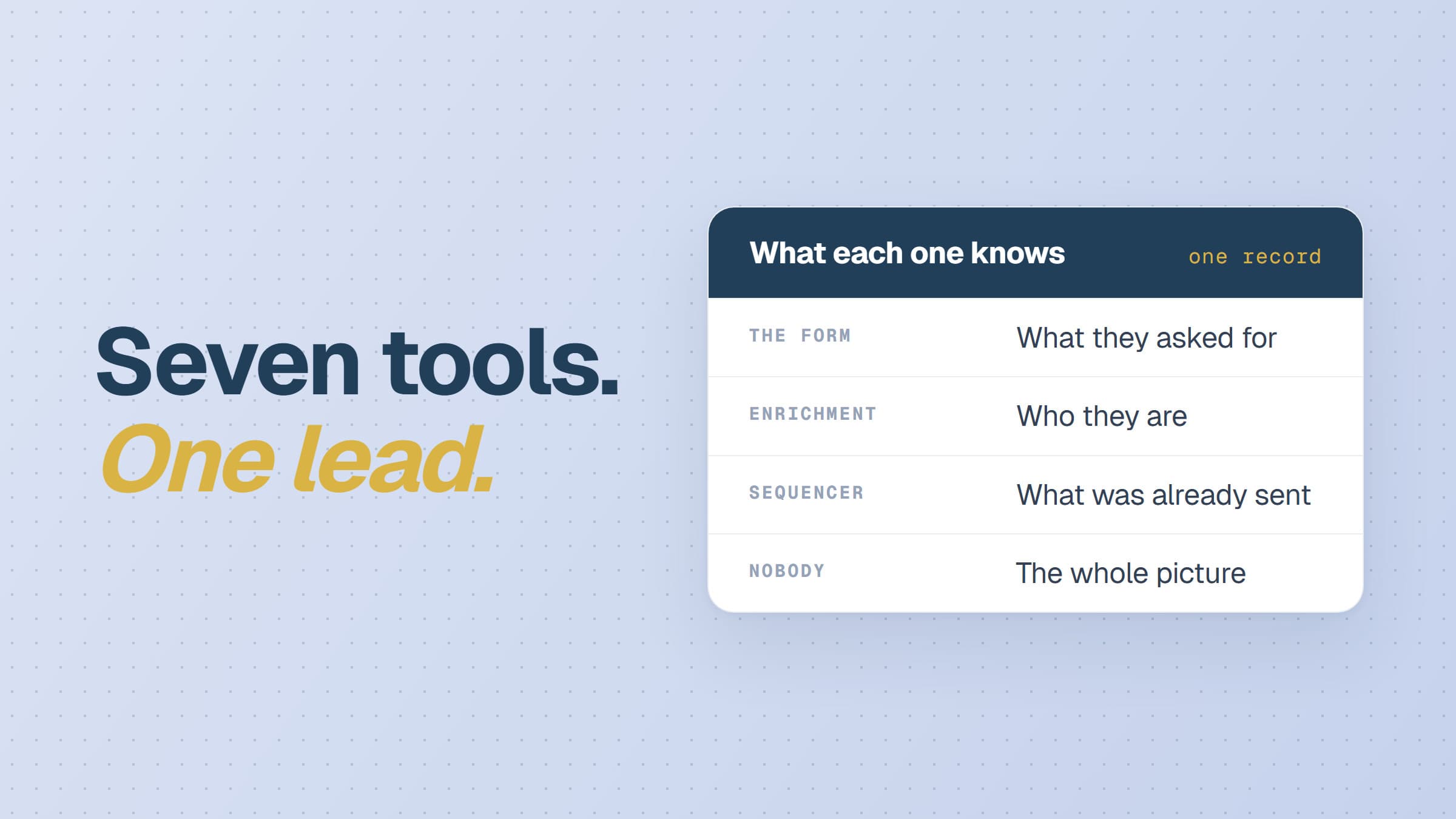
The form reports a submission. The router reports an assignment. The sequencer reports a send. Every tool is telling the truth about its own job, and nothing in the chain owns the outcome. So when a lead is mishandled, no system has failed, and no report shows it. We went deep on this in Seven tools, one lead.
Nobody holds the whole picture
The form knows what they asked. Enrichment knows who they are. The sequencer knows what's been sent. The chat widget knows what they asked at eleven at night. The rep walking into the call knows none of it, unless they visit each tool in turn, which is exactly what gets skipped on the busiest days.
It breaks when someone leaves
This is the one that keeps revenue leaders up at night once they've seen it. The logic that runs your pipeline, which leads go where, what counts as qualified, what happens when a meeting is cancelled, lives in automations that one or two people understand. When they leave, the system doesn't stop. It starts degrading, slowly, in ways nobody can trace.
What the alternative looks like
The answer isn't fewer logos for the sake of it. A stack of three tools with the same seams is still a Franken-stack. The thing worth wanting is a system: one record that holds every lead and account from first signal to booked meeting, every step running in order on it, and the rules written somewhere anyone on the team can read and change.
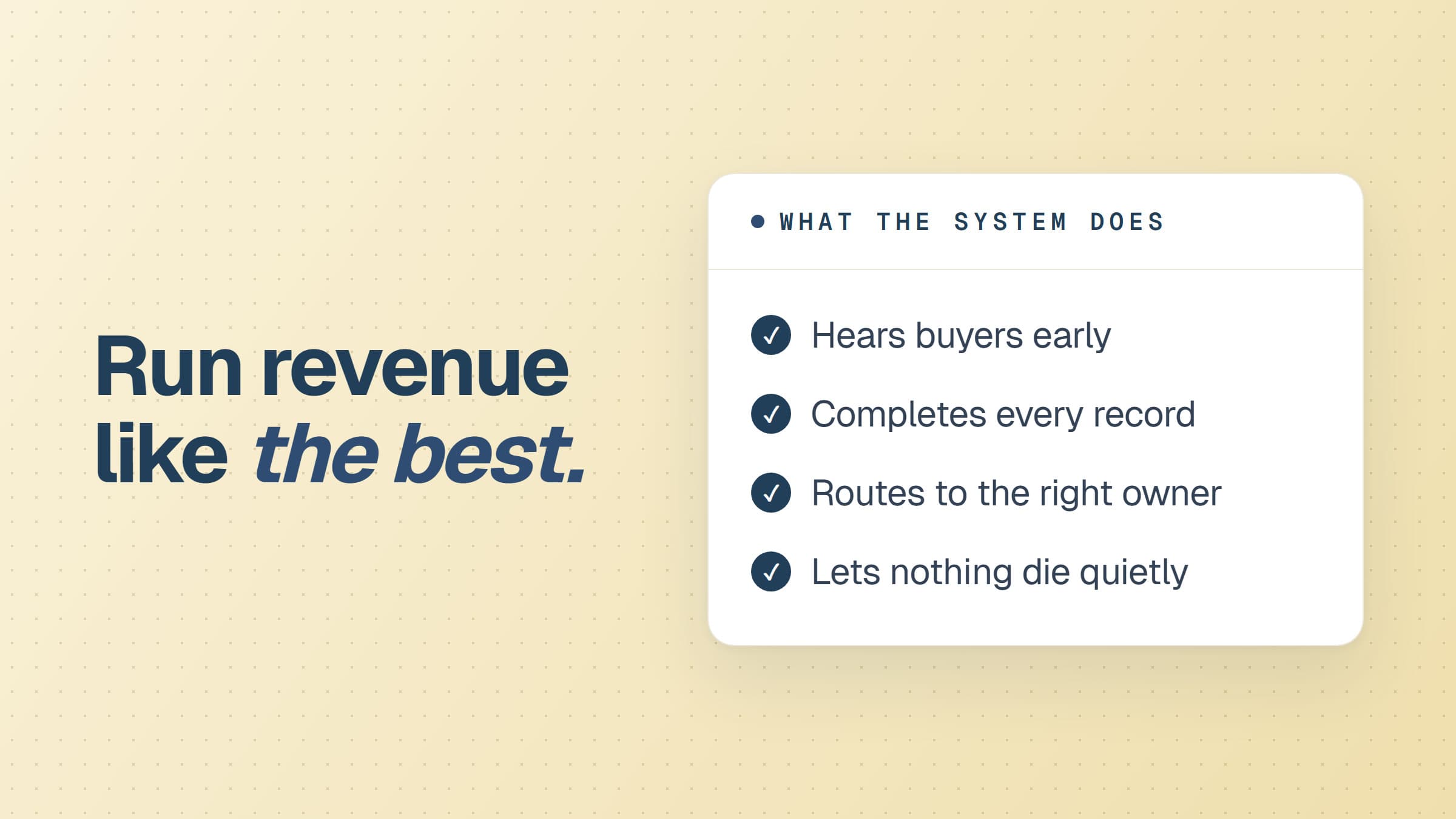
That's what the best B2B teams spent years building, and it's the standard worth measuring your own stack against. We've laid out what it does in how the best B2B teams run revenue. If you'd rather start with a quick gut-check, try the six signs.
How Lazure approaches this
Lazure replaces the layers, not just the logos. Prospecting across 500M+ people and 95M+ companies, waterfall enrichment across 50+ providers, AI research, forms, chat, website visitor identification, ICP scoring, ownership-aware routing, a built-in calendar, email and LinkedIn sequences, an AI SDR trained on your knowledge base, and meeting recovery, all on one record and in sync with HubSpot, Salesforce, Attio or Zoho.
The glue layer goes too. Workflows can be described in plain English and built for you, so the logic lives somewhere your whole team can read it, not in one person's head. You can see how it's packaged for your motion on the pricing page, or book a demo and we'll map your current stack against it, live.