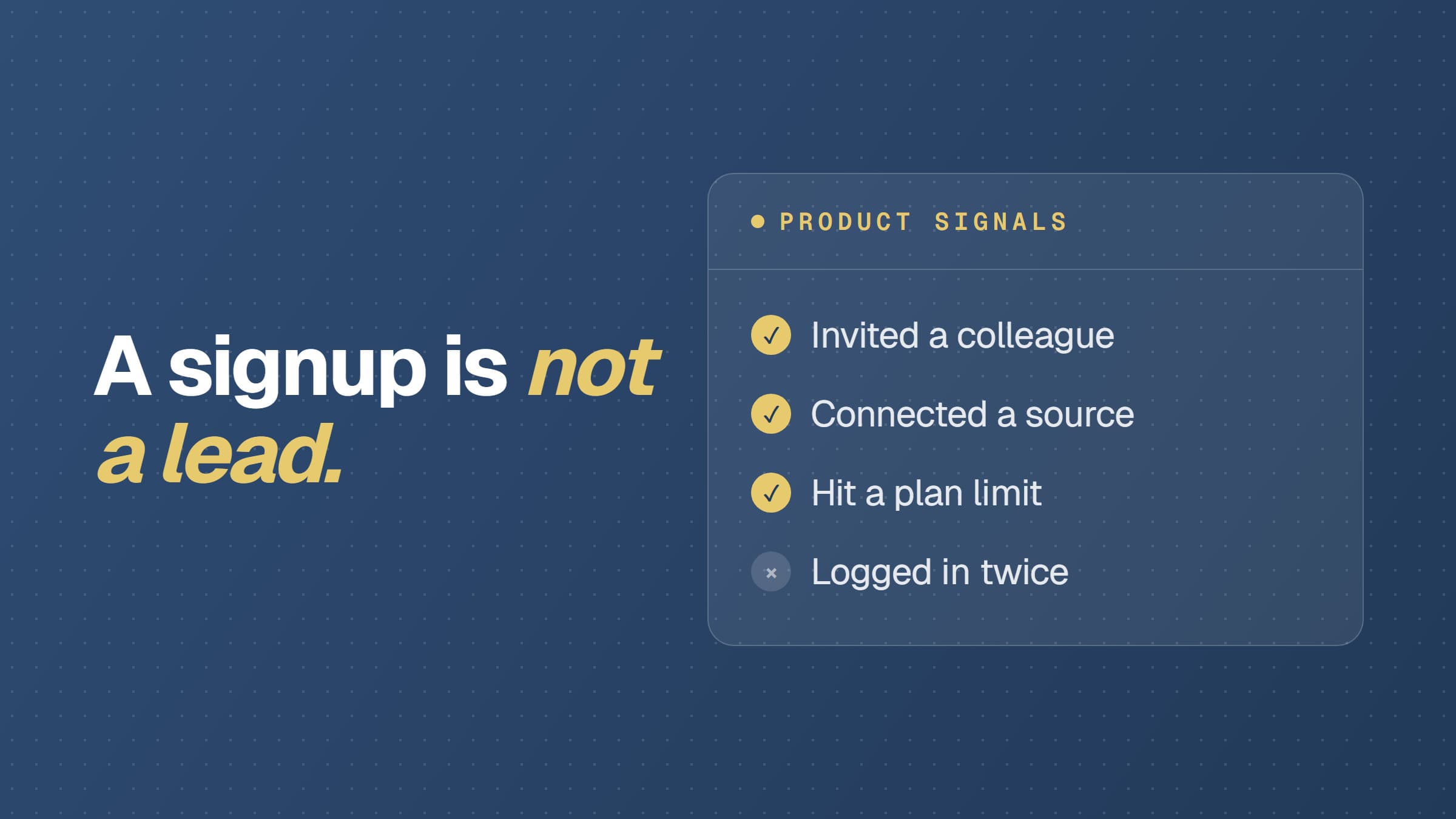

Your demand generation works. People arrive, read three pages, and leave. Around 98% of B2B website visitors never fill in a form, so your reporting shows the two or three percent who did, and counts the rest as traffic.
Some of that traffic was exactly who you are trying to reach. They read the pricing page, looked at an integration, and decided to think about it. Nothing in your funnel records that they existed.
This is a real gap and it is also the most oversold problem in go-to-market software, so it is worth separating what can honestly be done from what gets promised.
The short version
- Realistic company-level match rates run 30–75%. Person-level is 20–40%, and vendor claims of 90% do not survive independent testing.
- Which pages they read matters more than how many.
- The signal should decide who you contact and what about, never the opening line.
- Without a rule for what happens next, visitor data becomes another dashboard nobody opens.
What is actually knowable
A visitor arrives with an IP address and a browser. From that, identity vendors can often tell you the organisation, accurately for companies with their own network, less so for remote workers on domestic connections, and not at all for consumer ISPs and VPNs. Independent 2026 testing puts realistic company-level match rates at 30–75% of B2B traffic, against vendor marketing that routinely claims 90%.
Resolving that to a named person is a different matter: the same testing puts person-level identification at 20–40%. It is also the part that makes buyers uncomfortable and the part regulators pay attention to. Worth knowing the trade-off behind those numbers, deterministic matching is more accurate and returns less; probabilistic returns more and includes false positives you will not be able to see.
Identify the company, not the person. Reverse-IP and identity vendors resolve a visit to an organisation reliably and to an individual much less reliably. Building on the company is honest and it is enough, you can find the right person there yourself.
Company-level is enough to be useful. If a target account is reading your pricing page this week, you do not need to know which employee it was. You need to know that the account is in market, and then go and find the right person the ordinary way.
Not all pages mean the same thing
The most common mistake is treating a visit as a visit. Traffic to your blog is mostly people who found an article. Traffic to pricing, to a comparison page, or to the integration your product needs is a different thing entirely.
Score the page, not the pageview. Someone reading your careers page is not your buyer. Someone reading pricing twice in a week is. Define the pages that mean something before you switch anything on.
Three or four pages usually carry all the signal: pricing, whatever your equivalent of a comparison page is, the integration or feature that acts as a qualifier, and the demo page they did not convert on. Depth beats breadth, two visits to pricing in a week says more than eleven pageviews across the blog.
Someone reading your careers page is not your buyer. Someone reading pricing twice in a week is.
The line between useful and unsettling
There is a version of this that makes people close the tab and never come back, and it is the version most teams try first.
Do not pretend you did not see them. The fastest way to make this creepy is an email that says “I noticed you were looking at our pricing page.” Use the signal to decide who to contact and what to talk about, not as the opening line.
The workable pattern is simple. Use the signal to choose the account and the topic. Then reach out for a reason that stands on its own, something about their business, their market, the problem the page you care about happens to solve. If the message would still make sense had you never seen the visit, you are on the right side of the line.
It is also worth being clear internally about what you are storing and for how long. Visitor identification is the part of a GTM stack most likely to attract a question from a customer's legal team, and the answer should not have to be improvised.
The part everyone skips
Most teams switch on identification, watch the dashboard for a fortnight, and quietly stop looking. The data was fine. What was missing was a rule.
A working setup answers three questions before anything is installed. Which page visits qualify. What happens automatically when one occurs, a Slack alert, a task, a sequence, an account added to a list. And who is responsible for the follow-up, by name.
Without those, you have bought a report. With them, an anonymous visit becomes an enriched company record, scored against your ICP, sitting in a rep's queue with a reason attached.
In Lazure the identification feed is a trigger like any other: it can enrich the company, score it, check whether the account already has an owner, and route it, without a person watching a dashboard for it.
What to expect
Be realistic about the ceiling. You will resolve a meaningful share of business traffic to companies, a smaller share to anything more precise, and a good portion of what you resolve will be existing customers, competitors and job applicants, which is why the suppression rules matter as much as the identification.
What is left is genuinely valuable: a short list of accounts that were reading something specific, this week, and never told you. That is a better outbound list than anything you can buy.
How Lazure uses the signal
Identification on its own is a report. What makes it pipeline is the rule that runs after it.

A visitor identification feed arrives as a webhook trigger, the same as any other source. The company is enriched, scored against your ICP, and checked against your CRM, which removes the existing customers, open opportunities and competitors that would otherwise make the list embarrassing.
What survives goes somewhere specific: a Slack alert with the enriched profile, a task with an SLA, an account added to a sequence, or a named rep notified. And because outbound and inbound share one record, a visit from an account already in a sequence changes what that sequence does rather than duplicating it.